
Hidden Costs of Cheap Websites: What You'll Really Pay
A cheap £500 website can cost £5,000+ long-term. Plugin fees, emergency fixes and lost customers that budget developers won't warn you about. Real UK pricing.

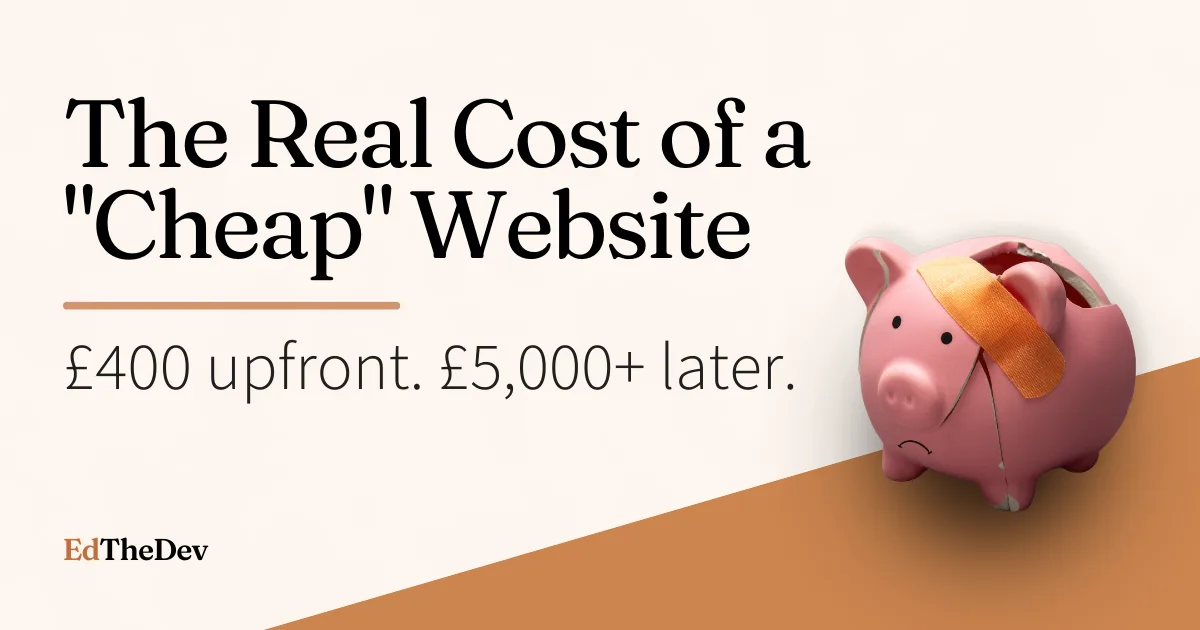
A cheap website often costs more long-term. Hidden costs include premium plugins (£100-200/year), emergency fixes, redesigns when you outgrow it, and lost revenue from poor performance. One Manchester business paid £400 for a cheap site — total cost ended up at £11,700.
“Why would I pay £3,000 when I can get a website for £400?”
It’s a fair question. And on the surface, a cheap website looks like a smart business decision.
But after 10 years building websites — including fixing hundreds of cheap ones that went wrong — I can tell you: the hidden costs of cheap websites make them almost never the cheap option.
Here’s what actually happens.
Table of Contents
- The True Cost Story
- Hidden Cost 1: The Plugin Tax
- Hidden Cost 2: Support That Doesn’t Exist
- Hidden Cost 3: You Outgrow It Fast
- Hidden Cost 4: Lost Revenue
- Hidden Cost 5: Your Time
- Hidden Cost 6: Fixing It Later
- Hidden Cost 7: Security Problems
- The Real Price Comparison
- What to Budget Instead
- Frequently Asked Questions
The True Cost Story
There’s a case study that perfectly illustrates this problem.
A small business in Manchester paid £400 for a website. Great deal, right?
Within 18 months, they’d spent:
- £400 initial build
- £1,800 on “essential” plugins and upgrades
- £2,400 on fixing problems and emergency support
- £900 on SEO work the site should have had from the start
- £6,200 on a complete rebuild when the cheap site couldn’t grow with them
Total: £11,700 — versus the £4,500 a proper build would have cost initially.
This isn’t unusual. Many businesses find themselves outgrowing cheap platforms within 18 months, often spending more fixing or replacing them than a quality build would have cost.
Hidden Cost 1: The Plugin Tax
Cheap WordPress sites are particularly guilty of this.
The base price looks great, but then you discover you need:
- A security plugin (£79/year)
- A backup plugin (£59/year)
- An SEO plugin (£99/year)
- A contact form plugin (£49/year)
- A speed optimisation plugin (£79/year)
- A booking or e-commerce plugin (£150+/year)
Suddenly your “cheap” hosting has £400-500/year in plugin costs sitting on top.
A properly built website includes these functions from the start, either built-in or using free alternatives the developer knows are reliable.
The Restaurant Example
For restaurant websites specifically, this gets worse. Cheap developers often don’t know how to integrate booking systems properly. You end up with:
- Clunky embedded widgets instead of seamless integration
- Booking systems that don’t match your site’s design
- No proper calendar syncing
- Manual processes because automations “weren’t included”
Every workaround costs you time. Time you could spend running your restaurant.
Hidden Cost 2: Support That Doesn’t Exist
Cheap websites come with cheap (or no) support.
You’ll hear phrases like:
- “Support is £50/hour after launch”
- “That wasn’t included in the original scope”
- “I’m not available for small changes”
Or worse: the developer simply stops responding. They’ve moved on to the next cheap project.
When something breaks — and it will — you’re either paying through the nose for fixes or starting from scratch with someone new.
What Proper Support Looks Like
A professional web developer or agency includes:
- Bug fixes for a defined period (usually 3-6 months)
- Training on how to update content yourself
- Responsive communication when issues arise
- Clear pricing for ongoing work
At EdTheDev, we include unlimited content updates in our monthly plans. Because we know restaurants need to change menus, update hours, and add events constantly.
Hidden Cost 3: You Outgrow It Fast
Cheap websites are built for the bare minimum. The moment you need something new, you hit a wall.
Common “you need a new website” triggers:
- Adding online ordering or bookings
- Expanding to multiple locations
- Wanting to rank better in Google
- Needing your site to load faster
- Rebranding your business
- Adding new services or products
If the foundation is weak, you can’t build on it. You have to start again.
The reality is that cheap websites often need frequent redesigns when they can’t adapt to business growth.
The Restaurant Reality
Restaurants evolve constantly. You add delivery, then events, then private dining, then gift vouchers.
A cheap brochure site built for “just a menu and contact form” can’t handle this. You’ll pay for a rebuild — or worse, you’ll stick with a site that doesn’t serve your customers properly, losing revenue every day.
Hidden Cost 4: Lost Revenue
This is the cost nobody calculates until it’s too late.
A slow website loses customers. Google research shows 53% of mobile visitors leave if a page takes over 3 seconds to load.
A confusing website loses customers. 68% of diners choose competitors when a restaurant website frustrates them.
A poorly optimised website doesn’t rank in Google. You become invisible to local searches.
The Maths
Let’s say your cheap website:
- Loads in 6 seconds instead of 2 (loses 25% of visitors)
- Has a bounce rate of 70% instead of 50% (poor UX)
- Ranks on page 3 of Google instead of page 1
If a proper website would bring you 100 customers/month, and your cheap one brings 40, that’s 60 lost customers.
At £30 average spend, that’s £1,800/month in lost revenue. Your “savings” on the cheap website vanish in weeks.
Hidden Cost 5: Your Time
Cheap developers expect you to do more work.
“Just send me the content and I’ll add it.” “You’ll need to source your own images.” “Write your menu out in a Word doc.” “I’ll need you to provide all the copy.”
For a restaurant owner working 60-hour weeks, this is impossible. You end up with placeholder text, missing pages, and a half-finished site that embarrasses you.
Professional developers include content support. They write headlines, source images, and work with you to get the words right — because they know a beautiful design with rubbish content is worthless.
Calculate Your Time Cost
If you spend 20 hours providing content, sourcing images, writing text, testing, and going back-and-forth with a cheap developer — and your time is worth £20/hour — that’s £400 of hidden labour.
Add that to the £400 website and you’ve already spent £800.
Hidden Cost 6: Fixing It Later
Here’s a dirty secret: most web developers make a significant chunk of their income fixing other people’s cheap websites.
Common fixes clients come to me for:
- “My site doesn’t show up on Google” — £500-1,500 to fix properly
- “It’s really slow on mobile” — £300-800 to optimise
- “I can’t update anything” — £200-500 to rebuild the backend
- “It got hacked” — £300-1,000+ for security fixes and cleanup
These aren’t problems with your website. They’re features of cheap development that weren’t included.
A properly built site is:
- Fast by default
- SEO-ready from day one
- Easy for you to update
- Secure and maintained
You’re not paying extra for these things. You’re paying for someone who knows to include them.
Hidden Cost 7: Security Problems
Cheap sites often have cheap hosting. Cheap hosting means:
- Shared servers with hundreds of other sites
- Outdated software that doesn’t get patched
- No automatic backups
- Slow response when things go wrong
Poor security from budget hosting leads to costly cleanups when sites get hacked or compromised.
For restaurants handling online bookings and potentially card payments, security isn’t optional. A breach could mean:
- Customer data exposed (hello GDPR fines)
- Site taken offline for days
- Reputation damage
- Emergency costs to fix it
The Real Price Comparison
Let’s compare actual 3-year costs:
Cheap Website Route
| Year | Cost | Notes |
|---|---|---|
| Initial | £400 | Basic build |
| Year 1 | £600 | Plugins, fixes, hosting |
| Year 2 | £1,200 | More fixes, redesign needed |
| Year 3 | £3,000 | Full rebuild |
| Total | £5,200 | Plus lost revenue |
Professional Website Route
| Year | Cost | Notes |
|---|---|---|
| Initial | £2,500 | Proper build OR £150/mo subscription |
| Year 1 | £150 | Hosting + minor updates |
| Year 2 | £150 | Hosting + minor updates |
| Year 3 | £150 | Hosting + minor updates |
| Total | £2,950 | No rebuilds, no emergencies |
The “expensive” option costs £2,250 less over three years.
What to Budget Instead
If you’re a UK small business in 2026, here’s what realistic website costs look like:
One-Off Payment
| Level | Budget | What You Get |
|---|---|---|
| Minimum Viable | £1,500-£2,500 | Professional template, mobile-ready, basic SEO |
| Standard | £2,500-£5,000 | Custom design, booking integration, content support |
| Premium | £5,000-£10,000 | Fully bespoke, complex features, ongoing support |
Monthly Subscription
| Level | Budget | What’s Included |
|---|---|---|
| Basic | £100-£150/mo | Professional design, hosting, basic updates |
| Professional | £150-£250/mo | Custom design, booking, unlimited updates |
| Premium | £250-£400/mo | Advanced features, priority support, marketing |
The subscription model works particularly well for restaurants because:
- No large upfront cost
- Updates included (menus change constantly)
- Support when you need it
- Site stays maintained and secure
For a full breakdown of what drives pricing, see our complete guide to website costs in the UK. Wondering what makes restaurant websites different? See our cost breakdown for restaurant websites specifically.
If you’re a Kent business looking for a website that won’t need rebuilding in two years, see our local web design packages.
How to Avoid the Cheap Website Trap
Before you sign with the lowest bidder, ask:
-
What’s included in the price? Get a detailed list. If it’s vague, walk away.
-
What happens after launch? Is support included? How much do updates cost?
-
Can I see sites you’ve built? Check they’re fast, work on mobile, and look professional.
-
Who hosts the site? Cheap shared hosting = slow sites and security risks.
-
What if I need changes later? Can the site grow with you?
-
What happens if something breaks? Get response times and costs in writing.
A professional developer will welcome these questions. A cheap one will dodge them.
Key Takeaways
- Cheap websites typically cost 2-3x more over 3 years when you include fixes, plugins, rebuilds, and lost revenue
- 60% of businesses outgrow cheap platforms within 18 months
- Hidden costs include: plugins (£300-500/year), support gaps, lost customers, your time, and eventual rebuilds
- Budget realistically: £1,500-£3,000 one-off or £100-200/month for a site that actually works
- Calculate lost revenue — a poor website costs far more than the “savings”
The cheapest option isn’t the one with the lowest price tag. It’s the one that costs least over time while actually doing its job.
Frequently Asked Questions
Related Articles

Affordable Web Design in Kent (2026)
Affordable web design in Kent from £65/month. What you get, what to avoid, and how Kent businesses get professional sites without agency prices.

Website Maintenance Plans UK (2026)
Compare website maintenance plans in the UK — from DIY to fully managed. What's included at each tier, typical costs, and how to choose the right plan.

Web Design Kent: How to Choose the Right Designer
Choosing a web designer in Kent? Local pricing (£65–£200/month), red flags to watch for and the questions to ask before you hire. Based in Canterbury.
Ready to get started?
Get a professional website that actually brings in customers — design, hosting, and support all included.